

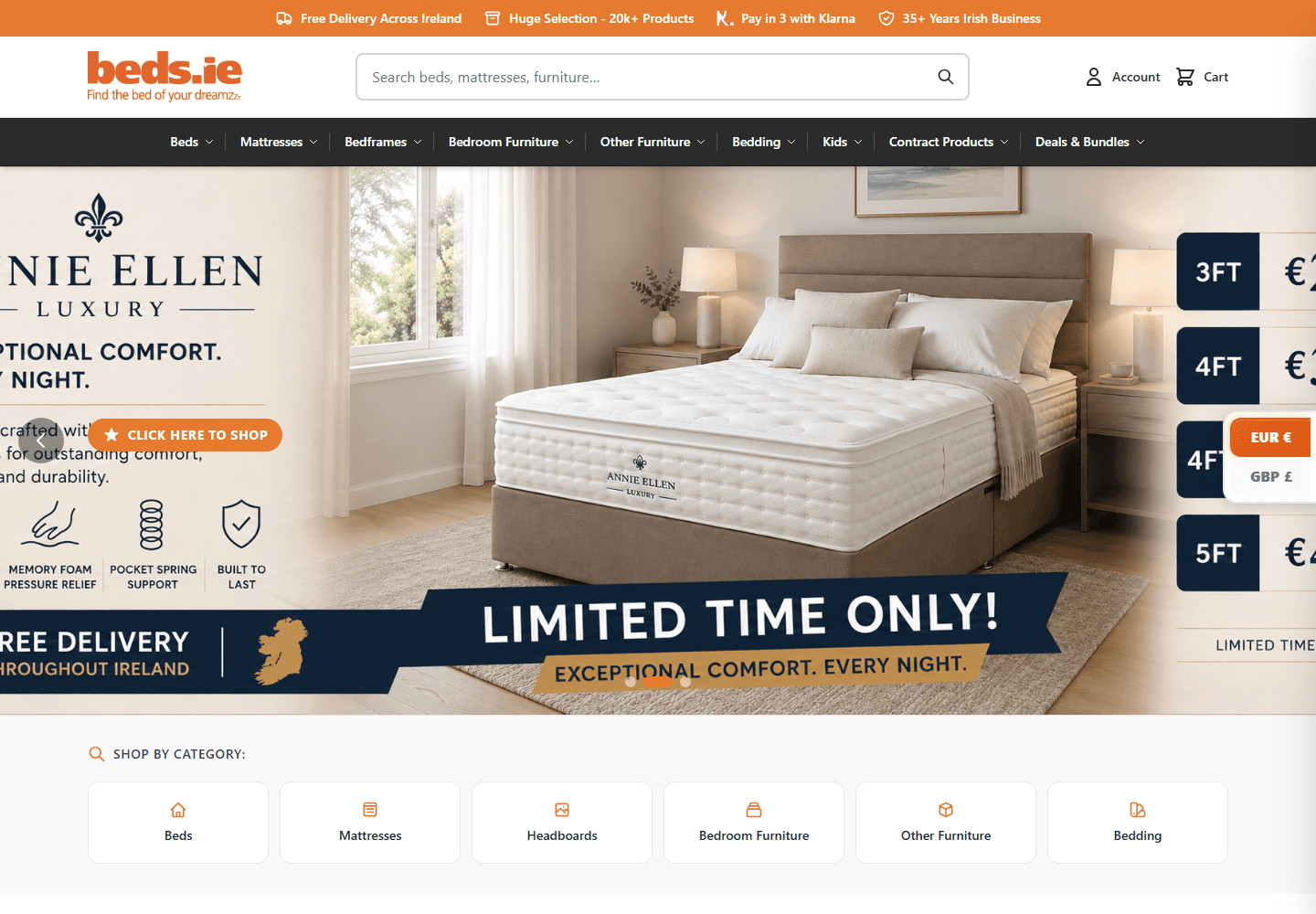
Beds.ie · E-commerce
From 672 to 7,781 organic clicks a month
672 → 7,781
Organic clicks / month
Growth · PPC
By SimonMeasured 4 September 2026
Paid search, Shopping and paid social managed inside a growth block. The fee does not move when your budget does, which is the whole point.
The short answer
PPC — pay per click — is advertising where you pay only when somebody clicks, across Google Search, Google Shopping, Microsoft Ads and the paid social platforms. UK agencies most often charge a percentage of your ad spend to manage it, commonly 10 to 20% and up to around 40% on small accounts. Cybrial charges none of it: PPC sits inside a growth block from £250 a month, so the management fee is the same whether you spend £500 or £5,000, and the tracking is set up before any money is spent.
Inside a growth block
from £250 /month
A block of hours spent on whatever moves the business — this, and everything else on the growth list. No percentage of your ad spend.
No minimum term. Move up, move down or stop whenever you see fit.
How the growth blocks workWhat you get
Search, Shopping, Performance Max and paid social, in whatever mix the account needs
Conversion tracking set up before the first pound is spent, including phone taps
Campaigns built from real keyword analysis rather than a keyword dump
Negative keywords maintained, which is where most wasted spend actually goes
Landing pages fixed rather than blamed — the same person does the site and the ads
Plain-English reporting: what went in, what came back, what changes next month
Measured, not claimed
A 17,000-product furniture retailer that was effectively invisible in search. Five months of retainer work on catalogue structure, product data and technical SEO took Beds.ie from under 700 organic clicks a month to nearly 8,000 — and monthly revenue more than tripled over the same period.
672 → 7,781
Organic clicks / month
+1,058% · April vs August 2026, full calendar months
Source: Google Search Console via the client's own database
There are three common models, and the difference between them matters most to the smallest advertisers.
| Model | Typical shape | Who it suits |
|---|---|---|
| Percentage of spend | 10–20% of budget, up to ~40% on small accounts | The agency, mostly — the fee rises with spend, not with results |
| Flat monthly fee | A fixed retainer per account or per platform | Stable accounts with predictable work |
| Block of hours | One number a month, spent on whatever the account needs | Businesses who want the ads, the site and the tracking done together |
Source: Cybrial’s own description of the market, written from the models we have been quoted against. No competitor’s published pricing is reproduced here.
The arithmetic against percentage-of-spend is the same one the Google Ads page makes and it does not get less true with a bigger keyword: managing a £2,000 monthly budget well takes roughly the same hours as managing a £1,000 one. The research is the same, the negatives are the same, the bidding is the same. Charging double is a convention, not a cost.
Where it genuinely bites is at the bottom. A £600 budget at 20% is £120 a month, which does not buy competent attention, so those accounts get a template and a quarterly glance — while a £20,000 account on the same percentage funds £4,000 of attention for work perhaps twice as complex. Here the ads sit inside a growth block from £250 a month, and the fee stays where it is when the budget moves.
Conversion tracking goes in before a pound is spent. Not after the first month, and not once there is “some data to look at”.
Without it the platform optimises toward clicks instead of customers, and every later conversation about performance becomes an argument about attribution. It is also where most inherited accounts are broken in a way nobody has noticed: conversions counted twice, page views counted as conversions, and phone calls not counted at all. For a trade or service business where most enquiries arrive by phone, an account optimised on form fills is spending your money chasing the wrong half of your customers.
A related point that costs UK advertisers real money: consent banners mean the platforms undercount. Anything relying on a cookie only sees the visitors who accepted one, so the true picture is always better than the dashboard says — and how much better depends on your banner. Knowing the size of that gap is the difference between pausing a campaign that works and scaling it.
Ads if you need enquiries this month. Search if you are building something that keeps paying after you stop. Most businesses want both, and the order depends on cash flow rather than principle.
The case worth being honest about is when ads are the wrong answer entirely. If a click in your category costs £15 and roughly one in twenty clicks becomes an enquiry, each enquiry costs about £300 in media before anybody has done any work — and if your average job is £400, that is not a channel, it is a hobby. Working backwards from your own cost per click answers this before you spend anything, and sometimes the answer is that the money belongs in search or conversion work instead.
That conversation is easier here than at a percentage-of-spend agency, because nobody earns more by talking you into a bigger budget.
There is no published PPC campaign case study on this site, because no client campaign result has been cleared for publication. This page is method and pricing until there is one.
What is evidenced is the Shopping side: the Merchant Centre work behind Beds.ie has 94.5% of 17,233 items approved, which is what makes a catalogue visible in Shopping at all. A feed is not a campaign, and it is not being offered as one.
If you are choosing purely on published campaign evidence, that is a real point in favour of a PPC specialist. What you get here instead is that the ads, the site, the tracking and the conversion work are done by the same person — and none of your ad spend goes to a management fee.
Locally
Greater Manchester is expensive to advertise in for some categories and surprisingly cheap in others, and the only way to know which you are in is to work backwards from your own cost per click rather than from a budget somebody suggested over the phone.
The sum is simple enough to do before you speak to anyone. If a click costs around £3 and one in twenty clicks becomes an enquiry, each enquiry costs about £60 in media, and £600 a month buys ten of them — enough to judge whether the leads are any good. At £15 a click the same reasoning gives a very different answer.
For most local service businesses here that lands between £300 and £1,000 a month to start. Below about £300 the account cannot gather enough data to be optimised, and you would be paying somebody to watch noise.
Written by Simon, who does the work.
Also inside the growth block
All of these sit under the growth block, where the pricing and the process are the same whichever you pick.
Technical, local and content SEO with the results measured in Search Console rather than a slide deck. Beds.ie went from 672 to 7,781 organic clicks a month in five months.
Catalogue structure, product data and shopping feeds — the three things that decide whether a large store is visible. Beds.ie went from 672 to 7,781 organic clicks a month in five months, with 94.5% of a 17,233-item feed approved.
The map pack sits above every other result on a local search, and getting into it is mostly not a website job. This is the work that decides it.
Crawlability, structure, index coverage, speed and structured data — the half of SEO that is engineering, and the half where the largest untouched gains usually are.
People increasingly ask ChatGPT, Google AI Overviews and Perplexity instead of scrolling results. AI optimisation is the work of making your business the answer those systems give — and of being honest about which parts of it can be measured.
Search and Shopping campaigns managed inside your growth block — not for a percentage of your spend. Agencies commonly take 10–20% of what you spend to manage it, and up to 40% on small accounts; the hours cost the same whatever your budget.
Facebook and Instagram campaigns — creative, audiences, tracking and reporting — managed inside your growth block, with artwork done in-house rather than billed separately.
Watching what people actually do on your site and removing whatever stops them getting in touch. Vehicles 2 Lease report form conversion moving from roughly 1% to roughly 4%.
Planned, designed and posted for you — as part of the growth block, so it serves the same goals as the website and the ads instead of running as a separate hobby.
GA4, Search Console, Google Ads and Meta conversions set up properly and reconciled, so every other decision is made on real numbers.
A list of what is wrong, in the order it is worth fixing, with the reason each one matters. Not a 90-page PDF from a tool with the logo changed.
The only audience you actually own. Everything else is rented from a platform that can change the rules on a Tuesday.
Pages written to answer a question somebody is actually asking, in a volume the business can sustain. Not a blog nobody reads, published fortnightly forever.
A genuine performance channel for some products and an expensive way to make content for most. Which one you are depends on the product, not the budget.
The most precise B2B targeting available anywhere, at the highest cost per click of any mainstream platform. Both halves of that sentence matter.
Sources
Cybrial live SERP reading, 4 September 2026: an AI Overview is present on the “ppc agency” result.
Beds.ie Google Merchant Centre, read 4 September 2026: 94.5% of 17,233 items approved. Client’s own account.
Cybrial published pricing: growth blocks from £250 a month, no percentage of ad spend, no minimum term.
Straight answers
Here it is a growth block from £250 a month, and the fee does not change with your budget. The common alternative is a percentage of ad spend — usually 10 to 20%, and up to around 40% on small accounts, which is where it hurts most.
Work backwards from your own cost per click rather than picking a number. For most local businesses that lands between £300 and £1,000 a month. Below about £300 the account cannot gather enough data to be optimised.
They answer different questions. Ads bring enquiries this month and stop when you stop paying; search compounds and keeps paying. If cash flow is tight, ads first — but fix the tracking and the landing page before either.
You should, always. Create them under your own business and give me access. An account owned by an agency means the campaign history — which is most of the accumulated value — does not leave with you.
Not yet. No client campaign result has been cleared for publication and this page says so rather than implying otherwise. The Shopping feed work is evidenced at 94.5% of 17,233 items approved on Beds.ie.
Google Search and Shopping most often, then Performance Max, Microsoft Ads and paid social where the audience is actually there. The block is spent where it works rather than across every platform for the sake of a report.
Send me the site and what you are trying to achieve this year. I will tell you honestly which block makes sense and what the first month would go on.