

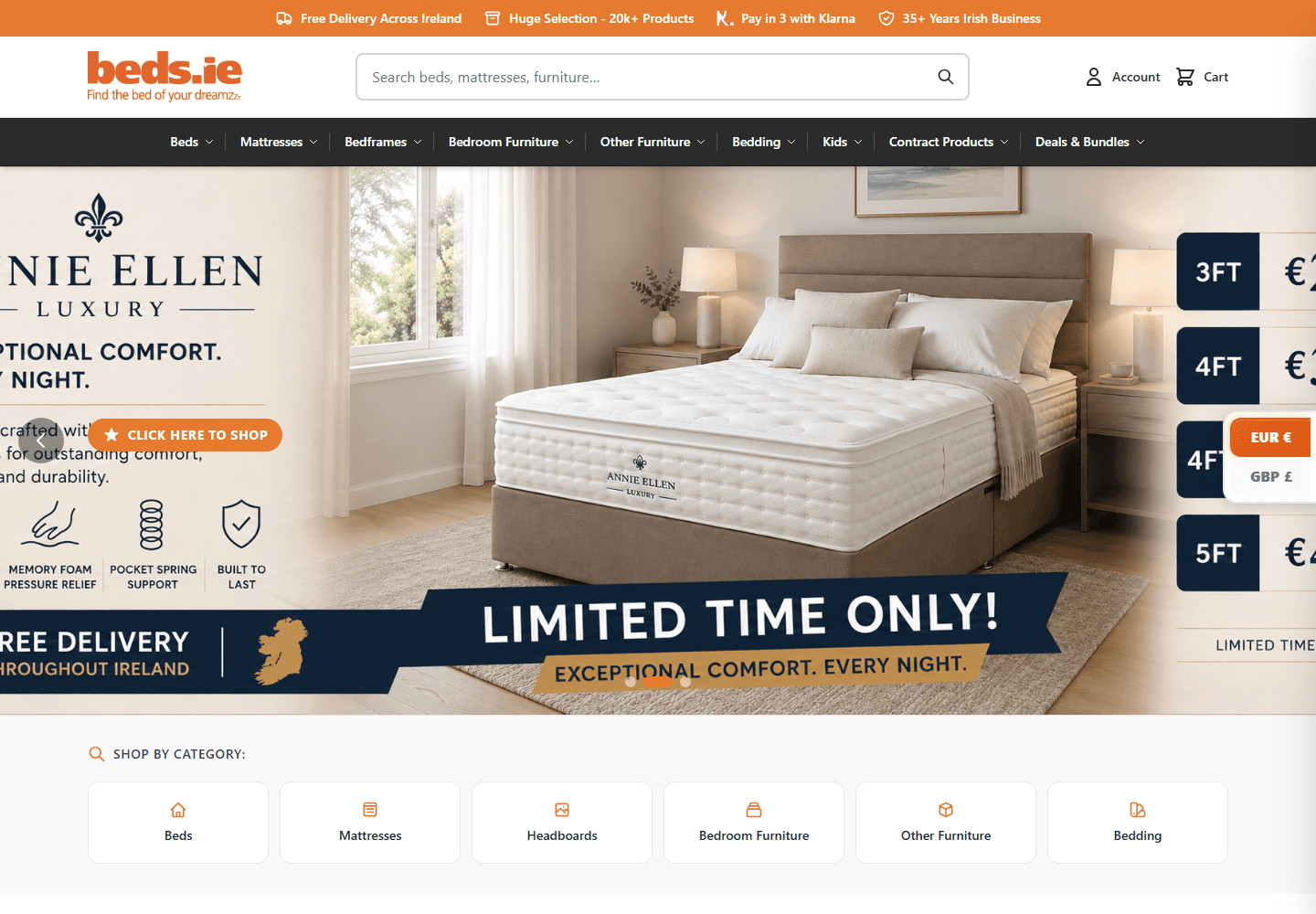
Beds.ie · E-commerce
From 672 to 7,781 organic clicks a month
672 → 7,781
Organic clicks / month
Growth · SEO
By SimonMeasured 4 September 2026
Technical, local and content SEO with the results measured in Search Console rather than a slide deck. Beds.ie went from 672 to 7,781 organic clicks a month in five months.
Inside a growth block
from £250 /month
A block of hours spent on whatever moves the business — this, and everything else on the growth list. No percentage of your ad spend.
No minimum term. Move up, move down or stop whenever you see fit.
How the growth blocks workWhat you get
Technical foundations: crawlability, structure, speed, structured data, redirects
Local SEO: Google Business Profile, location pages that earn their place, consistent details
Keyword analysis and content built around what people actually search for
E-commerce SEO: catalogue structure, product data, Merchant Centre
Search Console in a database you can query, so progress is measured not argued
Measured, not claimed
A 17,000-product furniture retailer that was effectively invisible in search. Five months of retainer work on catalogue structure, product data and technical SEO took Beds.ie from under 700 organic clicks a month to nearly 8,000 — and monthly revenue more than tripled over the same period.
672 → 7,781
Organic clicks / month
+1,058% · April vs August 2026, full calendar months
Source: Google Search Console via the client's own database
You will be dealing with one person, and that person is the one doing the work. If you email about a ranking, the reply comes from whoever changed the thing. If a project ever needs a specialist, you are told first and it is on the quote before it happens.
That matters more in SEO than in most disciplines, because the work is a long sequence of small judgements and almost all of the value is in knowing the site. A month of hours from somebody who built your site and reads its Search Console every month goes considerably further than a month from somebody learning it from a spreadsheet.
The clearest evidence is Beds.ie: an Irish furniture retailer with more than 17,000 products that was, in search terms, largely invisible. Five months of work on catalogue structure, product data and technical foundations took it from 672 to 7,781 organic clicks a month, impressions from 38,608 to 282,069, average position from 17.4 to 12.2, and the number of distinct queries the site appears for from 5,189 to 24,054. All Search Console figures, April against August 2026, full calendar months.
SEO is four jobs sold under one word. A proposal that does not say which of them it covers is not a proposal, so here is what a block of hours goes on, and in roughly what order.
What you will not get: a guarantee of position one, a monthly PDF of vanity metrics, or a keyword list with volumes attached and no discussion of what the site would have to become to deserve them. Volume is the easy half.
This is the advice that costs me work and saves clients money, so it goes near the top rather than buried at the bottom.
On 4 September 2026 I read the live UK results for the searches this studio cares about. A local pack — the map with three businesses on it — sat above the ordinary results on "web design manchester", "seo agency manchester", "google ads agency manchester" and "web design bolton", among others. The businesses in it were showing between 23 and 69 reviews at ratings of 4.9 to 5.0.
Getting into that pack is mostly not a website job. It is a claimed and complete Google Business Profile, the right primary category, business details identical everywhere they appear, and genuine reviews from real customers who say something specific. For a trade, a practice or a local retailer, that work costs almost nothing and will out-earn several months of content.
The scale of it is easy to underestimate. "Web designer near me" and "website designer near me" are searched 6,600 times a month each in the UK, and "web design near me" 2,900. No page ranks for "near me". A profile does.
| Window | What you should see |
|---|---|
| Weeks 1–4 | Technical fixes shipped, tracking made honest, a true baseline established. No traffic change yet. |
| Months 2–3 | Impressions rise before clicks do. The site appears for more queries at poor positions — the first real signal, and the one most easily dismissed. |
| Months 3–6 | Positions improve on terms that were nearly there, and clicks follow. On Beds.ie the curve was visible from month two and the result landed at month five. |
| Months 6–12 | Competitive and head terms move, if they are going to. Content published in month two starts earning. |
Anyone promising a faster timeline than that on a competitive term is describing something other than SEO. Anyone refusing to give a timeline at all is protecting themselves rather than informing you.
Locally
Manchester is a genuinely competitive search market — established agencies, a strong freelance scene, and head terms that several of them have been working on for years. That has two practical consequences for a local business.
The first is that the head terms are a twelve-month project and should be treated as one. The second, and more useful, is that the local pack and the long tail are not: a Greater Manchester business with a properly built site, a complete Google Business Profile and ten genuine reviews can be visible for the searches that actually bring work — service plus town, "near me", the specific thing you do — inside a few months.
I work across Greater Manchester and beyond it: Manchester itself, Bury, Rochdale, and further out to Northern Ireland and the Republic where existing clients are. If the honest answer for your business is that you should spend the money on your Google Business Profile rather than on me, that is the answer you will get.
Written by Simon, who does the work.
Also inside the growth block
All of these sit under the growth block, where the pricing and the process are the same whichever you pick.
Catalogue structure, product data and shopping feeds — the three things that decide whether a large store is visible. Beds.ie went from 672 to 7,781 organic clicks a month in five months, with 94.5% of a 17,233-item feed approved.
The map pack sits above every other result on a local search, and getting into it is mostly not a website job. This is the work that decides it.
Crawlability, structure, index coverage, speed and structured data — the half of SEO that is engineering, and the half where the largest untouched gains usually are.
People increasingly ask ChatGPT, Google AI Overviews and Perplexity instead of scrolling results. AI optimisation is the work of making your business the answer those systems give — and of being honest about which parts of it can be measured.
Search and Shopping campaigns managed inside your growth block — not for a percentage of your spend. Agencies commonly take 10–20% of what you spend to manage it, and up to 40% on small accounts; the hours cost the same whatever your budget.
Facebook and Instagram campaigns — creative, audiences, tracking and reporting — managed inside your growth block, with artwork done in-house rather than billed separately.
Watching what people actually do on your site and removing whatever stops them getting in touch. Vehicles 2 Lease report form conversion moving from roughly 1% to roughly 4%.
Planned, designed and posted for you — as part of the growth block, so it serves the same goals as the website and the ads instead of running as a separate hobby.
GA4, Search Console, Google Ads and Meta conversions set up properly and reconciled, so every other decision is made on real numbers.
Paid search, Shopping and paid social managed inside a growth block. The fee does not move when your budget does, which is the whole point.
A list of what is wrong, in the order it is worth fixing, with the reason each one matters. Not a 90-page PDF from a tool with the logo changed.
The only audience you actually own. Everything else is rented from a platform that can change the rules on a Tuesday.
Pages written to answer a question somebody is actually asking, in a volume the business can sustain. Not a blog nobody reads, published fortnightly forever.
A genuine performance channel for some products and an expensive way to make content for most. Which one you are depends on the product, not the budget.
The most precise B2B targeting available anywhere, at the highest cost per click of any mainstream platform. Both halves of that sentence matter.
Straight answers
Beds.ie took five months to go from 672 to 7,781 organic clicks a month, and the curve was visible from month two. Local businesses with less competition can move faster; it depends on where you start and who you are up against.
No, and anyone who does is selling something else. What you get is the work, done properly, and the Search Console numbers every month so you can see whether it is working.
The build includes proper titles, metadata and structure. Ongoing SEO — the part that compounds — is what the growth blocks are for.
Growth blocks start at £250 a month with no separate management fee. UK agencies typically charge £1,000 to £3,000 a month for a competitive campaign. There is a full breakdown of what each level buys in the SEO cost guide.
Claim and complete your Google Business Profile and ask ten happy customers for a review. For a business serving a place, that will out-earn the first several months of a small retainer, and it costs nothing but an afternoon.
Send me the site and what you are trying to achieve this year. I will tell you honestly which block makes sense and what the first month would go on.