

Pro Pave · Landscaping
A Manchester trade site that loads in 0.68 seconds
0.68s
Full page load
Growth · Local SEO
By SimonMeasured 4 September 2026
The map pack sits above every other result on a local search, and getting into it is mostly not a website job. This is the work that decides it.
Inside a growth block
from £250 /month
A block of hours spent on whatever moves the business — this, and everything else on the growth list. No percentage of your ad spend.
No minimum term. Move up, move down or stop whenever you see fit.
How the growth blocks workWhat you get
Google Business Profile claimed, completed, categorised and kept current
A review strategy that asks the right customers for the right specifics — and never fabricates one
Business details made identical everywhere they appear: site, profile, directories, socials
Location and service pages that earn their place instead of repeating a town name
Local search data for your actual town, so the targets are chosen rather than assumed
Measured in Search Console and profile insights, monthly, in full calendar months
Measured, not claimed
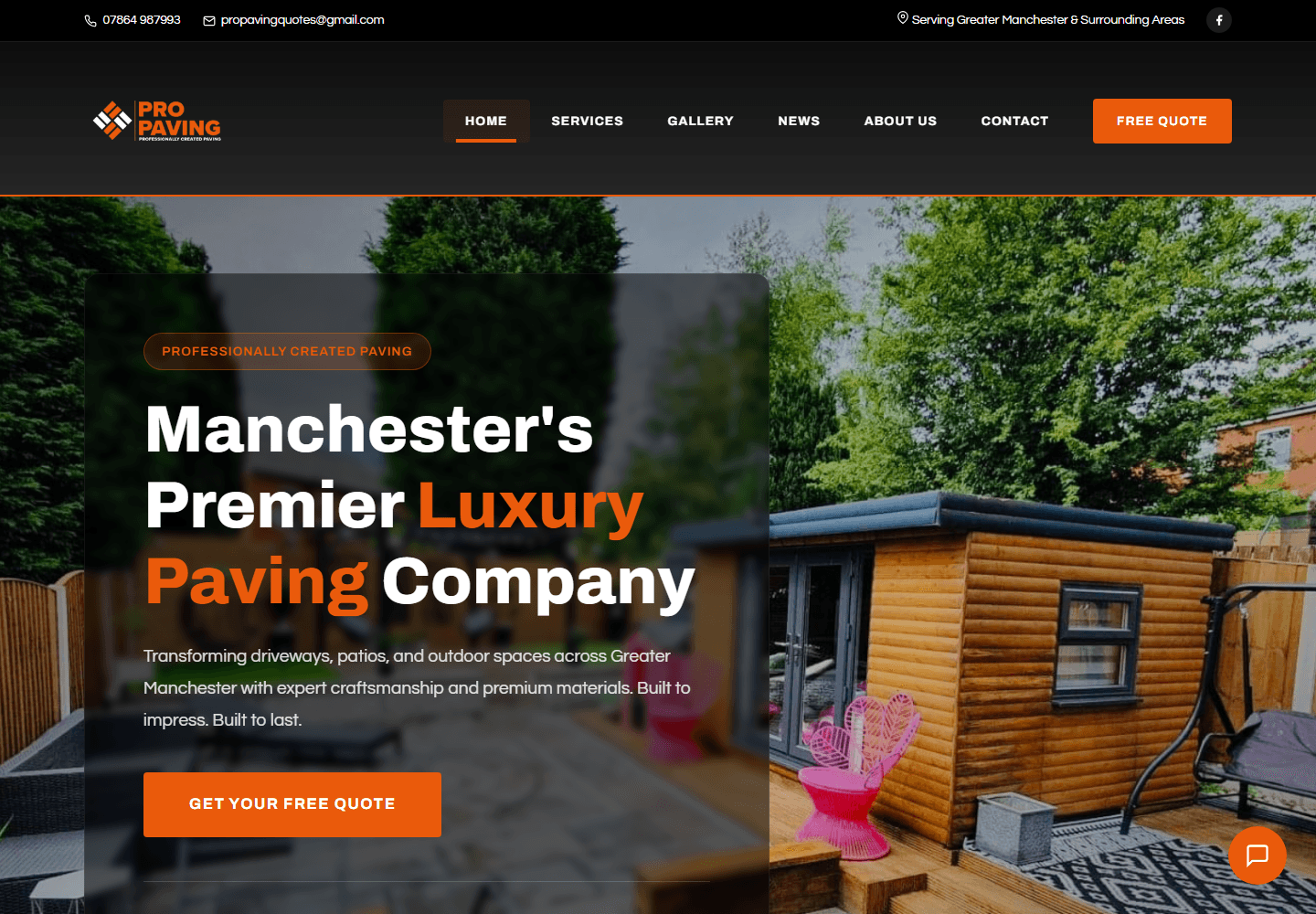
A local paving company competing for high-value domestic work across Greater Manchester. Built to load almost instantly on a phone at the kerbside, and written to rank for the searches that actually bring quote requests.
0.68s
Full page load
live homepage, cold measurement
Source: Browser Navigation Timing, 4 Sep 2026
On 4 September 2026 I read the live UK results for the searches this studio cares about. A local pack — the map with three businesses on it — sat above the ordinary results on "web design manchester", "seo agency manchester", "google ads agency manchester" and "web design bolton", among others. The businesses in it were showing between 23 and 69 reviews at ratings of 4.9 to 5.0.
That is the whole argument. For a business that serves a place, three listings and a map occupy the space above everything a website can win, and the entry requirements are a complete profile and genuine reviews rather than a page of copy.
The scale is easy to underestimate. "Web designer near me" and "website designer near me" are searched 6,600 times a month each in the UK, and "web design near me" 2,900 — 18,280 across the family. No page ranks for "near me". A profile does.
In rough order of impact, from doing this on trade and service sites rather than from a checklist.
Notice that four of the six happen outside your website. That is why this is a separate discipline from the rest of the SEO work, and why a growth block spent on it in month one often returns faster than anything else on the list.
This needs saying plainly because the industry is full of people who will not say it. Under the Digital Markets, Competition and Consumers Act 2024, publishing or commissioning fake reviews, or presenting incentivised reviews as organic, is a banned practice with real penalties attached.
What works and is legitimate: asking every genuinely satisfied customer, at the moment the job is finished, with a direct link that takes two taps. Asking for specifics rather than praise — what the job was, what the problem had been — because a specific review is more persuasive to a human and more useful to the algorithm. Answering every review, including the poor ones, briefly and without defensiveness.
What this site will never do is display a rating or a review count it cannot show verbatim from its source. The previous version of this site carried an aggregate rating claiming 47 reviews against three testimonials in the code; it was removed along with the page it sat on, and the reasoning is written up on the measurement policy page.
The standard advice is to build a page for every town you serve. The standard result is twenty near-identical pages with the town name swapped, which Google has been discounting for a decade and which makes a site look worse rather than better.
A location page earns its place when it contains something that could only have been written about that place. On this site that means the trades and industries a town actually runs on, what that does to the kind of enquiry a business there gets, and what a site has to do about it — different for every town because the towns are different. Where there is no client in a town, the page says so in the first screen rather than implying a local office.
For a client, the equivalent is usually the work itself: the jobs done there, the specific problems that area throws up, the reason a search in that town differs from the one next door. If a page cannot carry any of that, it should not exist, and the borough should be a line on the hub instead.
That last point catches people out constantly. If somebody shows you a rank-tracking screenshot for a local term with no statement of where it was measured from, it is decoration.
Locally
Greater Manchester is a genuinely competitive local market and a strikingly uneven one, which is the useful part. Checked borough by borough, the differences are large: nobody at all is competing for the Wigan or Oldham searches, while twelve miles away the Bolton equivalents have three established firms on them and Stockport is the hardest town in the county. Two similar businesses in neighbouring boroughs face completely different amounts of work to become visible.
That matters because it changes what a local business should do first. In Wigan or Oldham the town terms are worth going after immediately. In Bolton or Stockport they are a twelve-month project and the map pack plus the long tail will bring work far sooner. Anyone selling you the same local package for both towns has not looked.
The area pages on this site publish that data town by town, free, whether or not you ever get in touch — Wigan, Bolton, Oldham, Stockport, Altrincham, Warrington, Bury, Salford, Tameside, Rochdale and east Cheshire.
Written by Simon, who does the work.
Also inside the growth block
All of these sit under the growth block, where the pricing and the process are the same whichever you pick.
Technical, local and content SEO with the results measured in Search Console rather than a slide deck. Beds.ie went from 672 to 7,781 organic clicks a month in five months.
Catalogue structure, product data and shopping feeds — the three things that decide whether a large store is visible. Beds.ie went from 672 to 7,781 organic clicks a month in five months, with 94.5% of a 17,233-item feed approved.
Crawlability, structure, index coverage, speed and structured data — the half of SEO that is engineering, and the half where the largest untouched gains usually are.
People increasingly ask ChatGPT, Google AI Overviews and Perplexity instead of scrolling results. AI optimisation is the work of making your business the answer those systems give — and of being honest about which parts of it can be measured.
Search and Shopping campaigns managed inside your growth block — not for a percentage of your spend. Agencies commonly take 10–20% of what you spend to manage it, and up to 40% on small accounts; the hours cost the same whatever your budget.
Facebook and Instagram campaigns — creative, audiences, tracking and reporting — managed inside your growth block, with artwork done in-house rather than billed separately.
Watching what people actually do on your site and removing whatever stops them getting in touch. Vehicles 2 Lease report form conversion moving from roughly 1% to roughly 4%.
Planned, designed and posted for you — as part of the growth block, so it serves the same goals as the website and the ads instead of running as a separate hobby.
GA4, Search Console, Google Ads and Meta conversions set up properly and reconciled, so every other decision is made on real numbers.
Paid search, Shopping and paid social managed inside a growth block. The fee does not move when your budget does, which is the whole point.
A list of what is wrong, in the order it is worth fixing, with the reason each one matters. Not a 90-page PDF from a tool with the logo changed.
The only audience you actually own. Everything else is rented from a platform that can change the rules on a Tuesday.
Pages written to answer a question somebody is actually asking, in a volume the business can sustain. Not a blog nobody reads, published fortnightly forever.
A genuine performance channel for some products and an expensive way to make content for most. Which one you are depends on the product, not the budget.
The most precise B2B targeting available anywhere, at the highest cost per click of any mainstream platform. Both halves of that sentence matter.
Straight answers
The work of making a business visible for searches tied to a place — including the map pack, which sits above the ordinary results on most local commercial searches. Much of it happens off your website: the Google Business Profile, reviews, and business details being consistent everywhere they appear.
Profile changes and review growth can move the map pack within weeks, which makes it the fastest-returning search work available. Page-based local ranking follows the normal timeline: impressions in month two, clicks by months three to six.
In the ordinary results, yes, with a page that genuinely serves that search. In the map pack, much less easily — proximity to the searcher is the largest factor and nobody controls it. Anyone promising you the pack in a town you have no presence in is overselling.
On the Manchester results read in September 2026, the businesses in the pack were showing 23 to 69 reviews at 4.9 to 5.0. Ten genuine, specific, recent reviews is a realistic first target and it puts most local businesses ahead of their immediate competition.
I can set up the asking — the right moment, the direct link, the wording that prompts specifics, and the process for answering them. I will not write them, buy them, or incentivise them: under the DMCC Act 2024 that is a banned practice, and it is also the fastest way to lose a profile.
Yes, it is one of the things the hours go on, and for a business serving a place it is usually where the first month should go. Blocks start at £250 a month with no minimum term.
Send me the site and what you are trying to achieve this year. I will tell you honestly which block makes sense and what the first month would go on.