

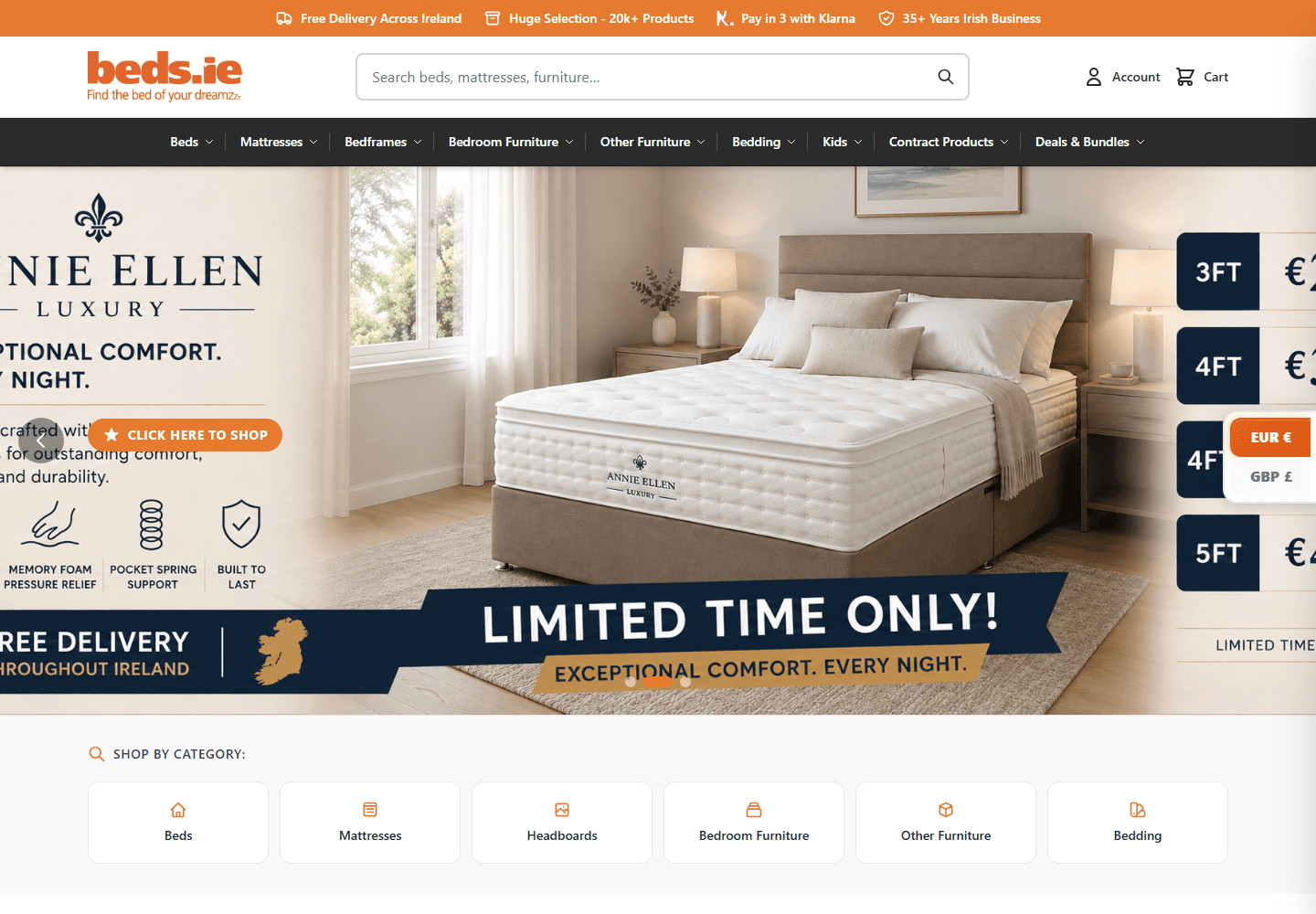
Beds.ie · E-commerce
From 672 to 7,781 organic clicks a month
672 → 7,781
Organic clicks / month
Growth · AI optimisation
By SimonMeasured 4 September 2026
People increasingly ask ChatGPT, Google AI Overviews and Perplexity instead of scrolling results. AI optimisation is the work of making your business the answer those systems give — and of being honest about which parts of it can be measured.
Inside a growth block
from £250 /month
A block of hours spent on whatever moves the business — this, and everything else on the growth list. No percentage of your ad spend.
No minimum term. Move up, move down or stop whenever you see fit.
How the growth blocks workWhat you get
Entity clarity: who you are, where you are, what you do — consistent everywhere AI systems read
Structured data that machines can quote, and none that the page does not support
Content written to be cited: direct answers, specifics, sources attached to figures
Google Business Profile, directories and citations kept accurate — the inputs these systems trust
A monthly check of fixed questions against the major assistants, with the transcripts kept
Measured, not claimed
A 17,000-product furniture retailer that was effectively invisible in search. Five months of retainer work on catalogue structure, product data and technical SEO took Beds.ie from under 700 organic clicks a month to nearly 8,000 — and monthly revenue more than tripled over the same period.
672 → 7,781
Organic clicks / month
+1,058% · April vs August 2026, full calendar months
Source: Google Search Console via the client's own database
Most of this is SEO with the emphasis moved. The page still has to be crawlable, fast and rendered — an assistant cannot cite a page it could not fetch — and authority still counts, because systems that cite sources prefer sources other people already trust.
Five things are genuinely different, and they are the work:
On 4 September 2026 I read fourteen live UK search results across the queries this studio cares about. Eight carried an AI Overview. Every "what is", "how much" and "…uk" query had one; the transactional local queries — "web design manchester", "seo agency manchester" — did not, and carried a local pack instead.
The encouraging finding for a business of this size: on the cost and AI-SEO queries, the AI Overview cited small UK studios rather than the large SEO tools. Clear, dated, first-hand pages appear to compete well above their weight in that format.
The same applies to llms.txt, which is currently sold hard by a lot of people. This site ships one, generated from its own route data. As of September 2026 no major provider has publicly confirmed reading it, and the guide here says so. It costs an hour, so it is worth doing; it is not worth a line on an invoice.
Six of those seven improve classic search as well, which is the honest argument for doing them regardless of how AI search settles. There is no version of the future in which clear, sourced, first-hand, technically sound pages turn out to have been a mistake.
Locally
The local dimension of this is more concrete than it sounds. Ask an assistant for a web designer in Manchester and the businesses it names are overwhelmingly the ones with a strong, consistent local presence — the same signals that decide the map pack, read by a different system.
So for a Greater Manchester business, the first AI optimisation job is almost never on the website. It is making sure the business is described identically wherever it appears, and that the Google Business Profile is complete and reviewed. That is cheap, it is checkable, and it moves both systems at once.
It is also worth knowing what a language model currently says about your business before spending anything. It is usually not what you would have written, and occasionally it is confidently wrong in a way that has been quietly costing you enquiries.
Written by Simon, who does the work.
Also inside the growth block
All of these sit under the growth block, where the pricing and the process are the same whichever you pick.
Technical, local and content SEO with the results measured in Search Console rather than a slide deck. Beds.ie went from 672 to 7,781 organic clicks a month in five months.
Catalogue structure, product data and shopping feeds — the three things that decide whether a large store is visible. Beds.ie went from 672 to 7,781 organic clicks a month in five months, with 94.5% of a 17,233-item feed approved.
The map pack sits above every other result on a local search, and getting into it is mostly not a website job. This is the work that decides it.
Crawlability, structure, index coverage, speed and structured data — the half of SEO that is engineering, and the half where the largest untouched gains usually are.
Search and Shopping campaigns managed inside your growth block — not for a percentage of your spend. Agencies commonly take 10–20% of what you spend to manage it, and up to 40% on small accounts; the hours cost the same whatever your budget.
Facebook and Instagram campaigns — creative, audiences, tracking and reporting — managed inside your growth block, with artwork done in-house rather than billed separately.
Watching what people actually do on your site and removing whatever stops them getting in touch. Vehicles 2 Lease report form conversion moving from roughly 1% to roughly 4%.
Planned, designed and posted for you — as part of the growth block, so it serves the same goals as the website and the ads instead of running as a separate hobby.
GA4, Search Console, Google Ads and Meta conversions set up properly and reconciled, so every other decision is made on real numbers.
Paid search, Shopping and paid social managed inside a growth block. The fee does not move when your budget does, which is the whole point.
A list of what is wrong, in the order it is worth fixing, with the reason each one matters. Not a 90-page PDF from a tool with the logo changed.
The only audience you actually own. Everything else is rented from a platform that can change the rules on a Tuesday.
Pages written to answer a question somebody is actually asking, in a volume the business can sustain. Not a blog nobody reads, published fortnightly forever.
A genuine performance channel for some products and an expensive way to make content for most. Which one you are depends on the product, not the budget.
The most precise B2B targeting available anywhere, at the highest cost per click of any mainstream platform. Both halves of that sentence matter.
Straight answers
It overlaps heavily — the technical foundations are shared — but AI systems weight things differently: entity consistency, quotable specifics, structured data and first-hand evidence matter more than keyword density. It is SEO with the emphasis moved, not a separate discipline with a separate retainer.
Only coarsely, and this page will not pretend otherwise. AI referral traffic shows up in analytics, and we ask a fixed set of questions of the major assistants monthly and keep the transcripts. There is no score, because no score I have seen is reproducible.
Unproven. It is widely adopted by publishers and, as of September 2026, no major AI search provider has publicly confirmed reading it. This site ships one because it costs an hour and is harmless — not because there is evidence it brings traffic.
No — it is one of the things the growth hours go on, alongside SEO, ads and conversion work. Whichever will move your business furthest that month.
Make your business details identical everywhere they appear, and complete your Google Business Profile. It is free, it takes an afternoon, and it moves both AI answers and the local map pack at the same time.
Send me the site and what you are trying to achieve this year. I will tell you honestly which block makes sense and what the first month would go on.