

Roch Sweets · E-commerce
A pick-and-mix builder for a sweet shop with 1,000 lines
0.86s
First contentful paint
Growth · Content
By SimonMeasured 4 September 2026
Pages written to answer a question somebody is actually asking, in a volume the business can sustain. Not a blog nobody reads, published fortnightly forever.
The short answer
SEO content marketing means publishing pages that answer questions people are actually searching for, so the site earns traffic it does not have to pay for. What separates it from blogging is that every page starts from a measured search — volume, difficulty and intent — rather than from an idea, and that pages are written to be the best answer rather than to hit a word count. Content sits inside a growth block from £250 a month here, and this site is built the same way: every page on it names the search data that justified writing it.
Inside a growth block
from £250 /month
A block of hours spent on whatever moves the business — this, and everything else on the growth list. No percentage of your ad spend.
No minimum term. Move up, move down or stop whenever you see fit.
How the growth blocks workWhat you get
Keyword research first — volume, difficulty and intent, so nothing is written on a hunch
The questions Google says searchers also ask, taken from the live results rather than guessed
Pages written to answer the query in the first paragraph, which is what AI Overviews lift
Real sources cited with the date they were read, because unsourced numbers get ignored
Internal linking planned as the pages are written, not bolted on afterwards
Existing pages improved before new ones are written, which is usually the cheaper win
Measured, not claimed
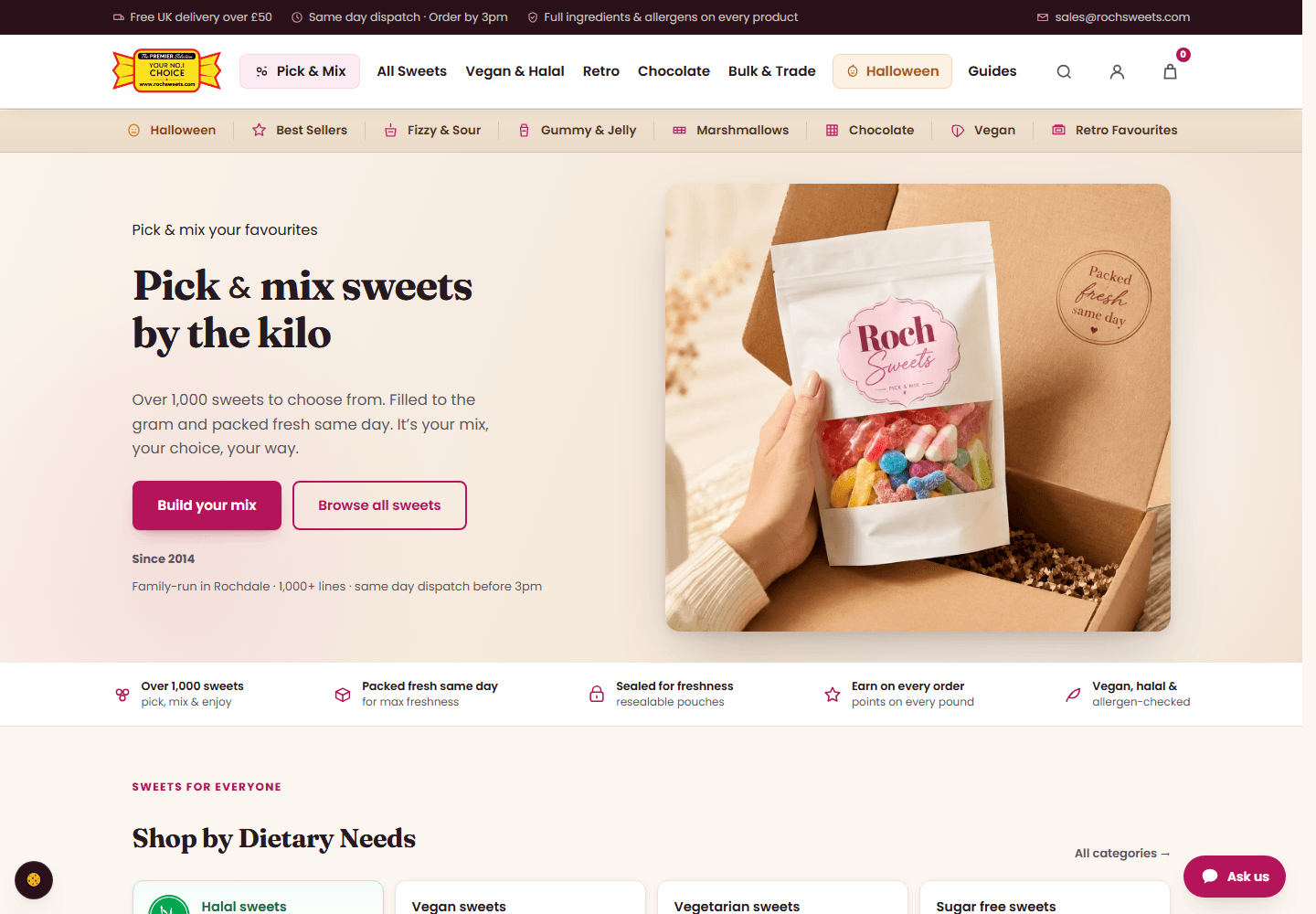
A family sweet shop in Rochdale, trading since 2014, selling over a thousand lines by the kilo. We built the store around the way people actually buy sweets — build your own mix, filled to the gram, dispatched the same day.
0.86s
First contentful paint
live homepage, photography-led
Source: Browser Navigation Timing, 4 Sep 2026
The failure mode of content marketing is publishing regularly. A fortnightly blog written from whatever occurred to somebody produces pages nobody searched for, which earn nothing and then need maintaining forever.
The alternative is to check first. Before a page is written it gets a monthly search volume, a difficulty score and a reading of what the results currently look like. If the volume is negligible or the difficulty is out of reach, that is a decision not to write it — and deciding not to write forty pages is often the most valuable outcome of the research.
This site is the worked example. Every service, area and industry page here publishes the search data that justified it, and the full map lives in the studio’s own content plan. That is not a flourish: it is the only way to show that the pages were chosen rather than churned.
An AI Overview sat above 25 of the 31 UK results we captured on 4 September 2026, up from 8 of 14 in an earlier pass the same week. That changes what a page has to do. The click is no longer guaranteed by ranking; being the source the Overview quotes is now part of the job.
What that means in practice is unglamorous and specific.
One encouraging finding from that capture, and it is the argument for a small studio doing this at all: on the cost and agency queries, the Overviews were citing small UK web studios rather than the large SEO tool blogs. A specific, sourced answer from a business that does the work beats a general one from a business that sells software about it.
Content sits inside a growth block from £250 a month rather than being priced per word or per article. Per-word pricing rewards length, and length is not what makes a page rank — a thorough 900-word answer beats a padded 2,000-word one, and both beat a 300-word page that answers nothing.
On timescale, be sceptical of anybody promising one. Roch Sweets is the fastest movement we have measured — impressions more than doubled inside the first week of work, from the client’s own Search Console — and that is a single early data point on one site, not a rate card. Most content work is measured in months, and a page published today is often at its most valuable a year from now.
Google’s published position is that it rewards helpful content regardless of how it was produced, and penalises content produced primarily to manipulate rankings. That is a statement about purpose, not about tooling, and it is the sensible way to think about it.
The practical problem with generated content at volume is not that a model wrote it. It is that a model has no first-hand information: it cannot tell you what a rebuild did to a client’s traffic, what a supplier actually charges, or what went wrong on a project in June. Those are the sentences that get cited, and they are exactly the ones that cannot be generated.
So the tooling is not the question. The question is whether the page contains anything that could only have been written by someone who did the work.
Locally
The most valuable content for a Manchester business is usually the least exciting: the page that says what you charge, the page that says how long it takes, and the page that says what happens if it goes wrong.
Those are the searches people actually run before they call, and most local sites do not answer any of them — which is why a competitor with a plain pricing page outranks a competitor with a better-looking one.
It also travels further than it looks. A page that genuinely answers “what does this cost in Manchester” tends to earn links and citations from people who were only looking for the number, and those are the links you cannot buy.
Written by Simon, who does the work.
Also inside the growth block
All of these sit under the growth block, where the pricing and the process are the same whichever you pick.
Technical, local and content SEO with the results measured in Search Console rather than a slide deck. Beds.ie went from 672 to 7,781 organic clicks a month in five months.
Catalogue structure, product data and shopping feeds — the three things that decide whether a large store is visible. Beds.ie went from 672 to 7,781 organic clicks a month in five months, with 94.5% of a 17,233-item feed approved.
The map pack sits above every other result on a local search, and getting into it is mostly not a website job. This is the work that decides it.
Crawlability, structure, index coverage, speed and structured data — the half of SEO that is engineering, and the half where the largest untouched gains usually are.
People increasingly ask ChatGPT, Google AI Overviews and Perplexity instead of scrolling results. AI optimisation is the work of making your business the answer those systems give — and of being honest about which parts of it can be measured.
Search and Shopping campaigns managed inside your growth block — not for a percentage of your spend. Agencies commonly take 10–20% of what you spend to manage it, and up to 40% on small accounts; the hours cost the same whatever your budget.
Facebook and Instagram campaigns — creative, audiences, tracking and reporting — managed inside your growth block, with artwork done in-house rather than billed separately.
Watching what people actually do on your site and removing whatever stops them getting in touch. Vehicles 2 Lease report form conversion moving from roughly 1% to roughly 4%.
Planned, designed and posted for you — as part of the growth block, so it serves the same goals as the website and the ads instead of running as a separate hobby.
GA4, Search Console, Google Ads and Meta conversions set up properly and reconciled, so every other decision is made on real numbers.
Paid search, Shopping and paid social managed inside a growth block. The fee does not move when your budget does, which is the whole point.
A list of what is wrong, in the order it is worth fixing, with the reason each one matters. Not a 90-page PDF from a tool with the logo changed.
The only audience you actually own. Everything else is rented from a platform that can change the rules on a Tuesday.
A genuine performance channel for some products and an expensive way to make content for most. Which one you are depends on the product, not the budget.
The most precise B2B targeting available anywhere, at the highest cost per click of any mainstream platform. Both halves of that sentence matter.
Sources
Cybrial live SERP reading, 4 September 2026: 31 UK results captured, an AI Overview present on 25 of them, up from 8 of 14 in an earlier pass the same week. On the cost and agency queries the Overviews cited small UK web studios rather than large SEO tool blogs.
Google Search Central published guidance on AI-generated content: helpfulness and purpose are what is assessed, not the method of production.
Roch Sweets Google Search Console, client’s own property: impressions more than doubled within the first week of work. Read 4 September 2026. A single early reading on one site, published as such.
Cybrial published pricing: growth blocks from £250 a month, no minimum term.
Straight answers
It sits inside a growth block from £250 a month rather than being priced per word. Per-word pricing rewards length, and length is not what makes a page rank.
Fewer than you think, and only ones with measured demand behind them. Two pages that answer real searches beat eight that answer none, and they cost less to maintain.
Usually months. The fastest movement we have measured was Roch Sweets, where impressions more than doubled inside the first week — one early data point on one site, not a promise.
Google’s published position is that it assesses whether content is helpful, not how it was produced. The practical limitation is that a model has no first-hand information, and first-hand information is what gets a page cited.
Improve first, almost always. A page already ranking on page two usually needs less work to move than a new page needs to exist, and the research to find those is quick.
Answer the query fully in the first paragraph, make every heading independently answerable, and put figures in the sentence with their source and date. An Overview quotes a passage, not a page.
Send me the site and what you are trying to achieve this year. I will tell you honestly which block makes sense and what the first month would go on.