

Beds.ie · E-commerce
From 672 to 7,781 organic clicks a month
672 → 7,781
Organic clicks / month
Websites · Headless
By SimonMeasured 4 September 2026
Splitting the shop front from the shop. Genuinely better for some businesses and an expensive mistake for most, and the difference is knowable before you start.
The short answer
Headless commerce means separating the customer-facing front end from the commerce platform behind it, so the shop front is a custom application talking to the platform over an API. It buys speed, design freedom and the ability to serve several channels from one catalogue — and it costs you the platform’s built-in front end, its theme ecosystem and a good deal of ongoing maintenance. It is worth it when the front end is a genuine competitive asset, and a waste when it is not.
Pricing
from £500
for the build, then from £50 a month hosting & care.
Deliberately competitive. We do not make our money on the build — we make it growing the business the site belongs to.
How pricing worksWhat you get
An honest assessment first: whether the front end is worth owning
Next.js front ends on Shopify, WooCommerce, Magento or a custom back end
Core Web Vitals treated as a build target rather than a post-launch surprise
The commerce logic left where it belongs — no reimplementing checkout
SEO built in from the start: server rendering, canonicals, structured data
A written account of what you are taking on, before you take it on
Measured, not claimed
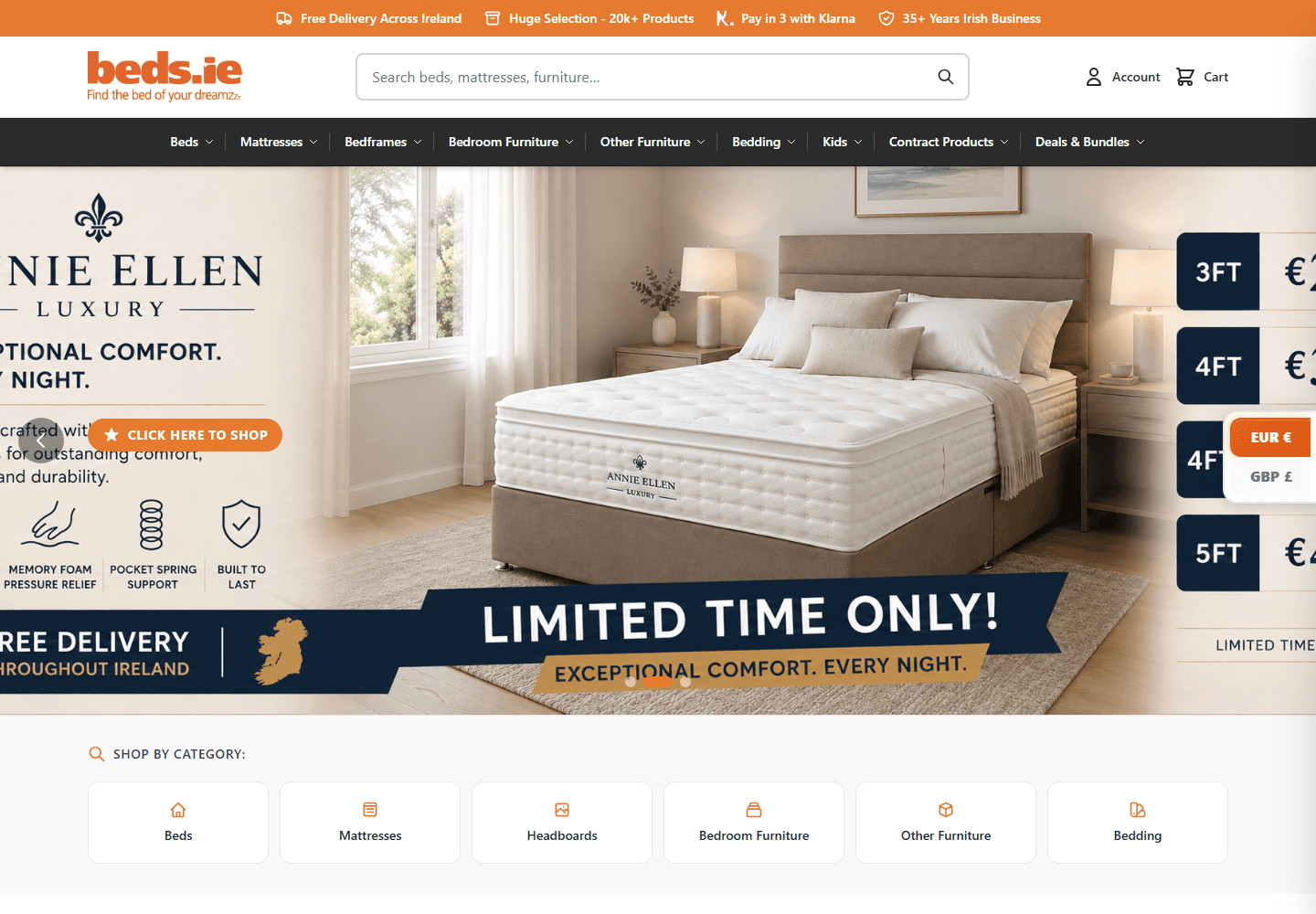
A 17,000-product furniture retailer that was effectively invisible in search. Five months of retainer work on catalogue structure, product data and technical SEO took Beds.ie from under 700 organic clicks a month to nearly 8,000 — and monthly revenue more than tripled over the same period.
672 → 7,781
Organic clicks / month
+1,058% · April vs August 2026, full calendar months
Source: Google Search Console via the client's own database
Three real things. Speed, because a purpose-built front end carries none of a theme’s accumulated JavaScript. Design freedom, because nothing has to be expressed as a variation on a template somebody else designed. And multi-channel, because the same catalogue can feed a website, an app and a kiosk without three copies of the data.
What it does not buy is a better shop. If the catalogue is thin, the photography is poor or the delivery promise is unclear, headless changes none of that and costs a great deal to discover it.
You give up the platform’s front end, which means you also give up its apps, its themes and every feature that assumed it. A Shopify app that injects a widget into the storefront has nothing to inject into. That is a normal trade, but it should be a deliberate one — a good number of headless projects stall at the moment somebody discovers that a review widget, a subscription app or a currency switcher no longer works.
You also take on permanent maintenance. A themed store keeps working while nobody touches it; a custom front end has dependencies that need updating, and the studio that built it needs to still be there. That is an argument for a monthly care plan rather than against headless, but it belongs in the decision.
A rough test that has held up well: if you can describe something the front end must do that the platform’s theme system genuinely cannot, headless is on the table. If the answer is “it would be faster” or “it would look better”, a well-built conventional store gets most of that for a fraction of the cost and complexity.
The other honest route is partial. Rendering the catalogue and product pages custom while leaving checkout on the platform captures most of the speed and SEO benefit and none of the payment risk. That is usually the better first step, and it is reversible.
Locally
Very few Manchester businesses need this, and saying so costs a studio nothing it should want to keep. The catalogue retailers and trade suppliers around the North West are far better served by a fast, conventional store than by a bespoke front end nobody but the original developer can change.
Where it does come up here it is usually a business with a genuine second channel — a trade portal alongside the public shop, or a showroom screen driven by the same stock — and in that case the multi-channel argument is real rather than aesthetic.
Written by Simon, who does the work.
Also under websites
All of these sit under web design in Manchester, where the pricing and the process are the same whichever you pick.
Bespoke WordPress builds for businesses that need to update the site themselves — designed properly, built lean, and fast on a phone.
WordPress shops where the way you sell does not fit a stock platform — a thousand lines sold by the gram, a 17,000-product catalogue, a buying journey nobody has built before.
Shopify and WooCommerce stores built around the parts that actually move revenue: product data, search, speed, and a checkout that gets out of the way.
When an off-the-shelf platform will not model your business, we build it properly — Next.js front ends, custom APIs and Supabase back ends, designed to be maintained.
Identity work that holds together everywhere it appears — logo, type, colour and the rules that stop it drifting — built alongside the website, not separately from it.
Rebuilding a site that already has customers is a different job from building one that has none. The traffic it already earns is an asset, and most redesigns lose some of it.
The platform large catalogues end up on, and the one most likely to be running three versions behind because nobody wanted to touch it.
Sources
Cybrial live SERP reading, 4 September 2026: an AI Overview is present on the “headless commerce” result.
Cybrial published pricing: large e-commerce and custom builds priced on application, from the hours the work takes.
Straight answers
The customer-facing front end is separated from the commerce platform and talks to it over an API. The platform still handles products, orders and payment; the front end is a custom application you own.
Only if you can name something the front end must do that a theme genuinely cannot. If the reason is speed or looks, a well-built conventional store gets most of the way there for far less.
You lose the platform’s themes and any app that injects into the storefront, and you take on permanent maintenance. Both are manageable and neither is usually costed properly at the start.
Yes, and it is often the right answer: render the catalogue and product pages custom, leave checkout on the platform. Most of the speed and SEO benefit, none of the payment risk, and it is reversible.
Send me what you sell, who buys it and anything you dislike about the current site. You get a straight reply on what I would build and a price — websites start from £500.