

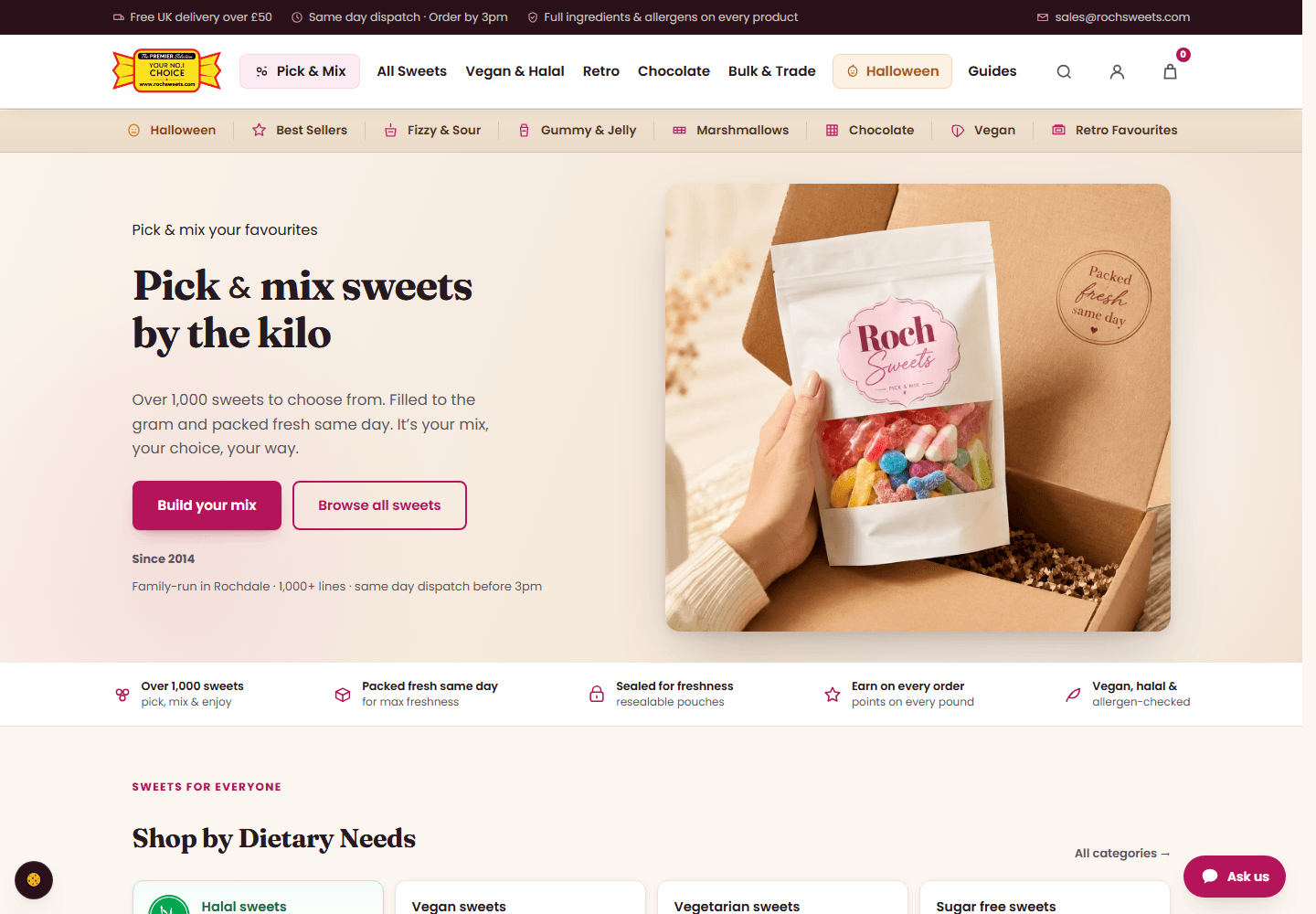
Roch Sweets · E-commerce
A pick-and-mix builder for a sweet shop with 1,000 lines
0.86s
First contentful paint
Websites · WooCommerce
By SimonMeasured 4 September 2026
WordPress shops where the way you sell does not fit a stock platform — a thousand lines sold by the gram, a 17,000-product catalogue, a buying journey nobody has built before.
Pricing
from £500
for the build, then from £50 a month hosting & care.
Deliberately competitive. We do not make our money on the build — we make it growing the business the site belongs to.
How pricing worksWhat you get
Bespoke WooCommerce builds, not a marketplace theme with your logo on it
Custom buying journeys where the platform has no answer — pick-and-mix by weight, gift lists, configurators
Catalogue structure and product data that search engines and shopping feeds can both read
Speed work that survives a real catalogue: Roch Sweets carries 1,000+ lines and paints in 0.86s
Merchant Centre feeds that report their rejections instead of dropping them
Hosting and care from £50 a month, and someone who answers when checkout breaks
Measured, not claimed
A family sweet shop in Rochdale, trading since 2014, selling over a thousand lines by the kilo. We built the store around the way people actually buy sweets — build your own mix, filled to the gram, dispatched the same day.
0.86s
First contentful paint
live homepage, photography-led
Source: Browser Navigation Timing, 4 Sep 2026
WooCommerce is WordPress with a shop on it, and the honest summary is that it gives you more freedom and more rope. It will let you build something unmaintainable. It will also let you model a business that no hosted platform can, which is the only reason to choose it.
The test I apply is simple: can the way you sell be described using the words "product", "variant" and "add to basket"? If yes, a hosted platform will probably serve you better and cost less to run. If no — if you sell by weight, by configuration, by appointment, by list, or by some rule that is particular to your trade — then the platform will fight you every month, and building it properly once is cheaper than working around it for years.
The received wisdom is that WooCommerce does not scale. In practice it scales fine and the thing that breaks is the data, not the platform.
Beds.ie is a WooCommerce store carrying more than 17,000 products. The work that made it visible was not platform work: the category structure was rebuilt so all 17,789 products sit in a crawlable hierarchy, product-data enrichment and validation were automated at source, and the Merchant Centre sync was wired to report rejections rather than silently dropping them. Between April and August 2026 organic clicks went from 672 to 7,781 a month and the shopping feed reached 94.5% approval — 16,281 of 17,233 items live.
The homepage still paints its first content in 0.42 seconds carrying that whole catalogue. If a large WooCommerce store is slow, the cause is almost always uncached queries and unoptimised images rather than the platform, and buying a bigger server to cover for it is the most expensive mistake in this category.
| WooCommerce | Shopify | |
|---|---|---|
| You own | Everything — code, data, hosting | Your data. The platform owns the rest |
| Monthly cost | Hosting and care only | Subscription, plus apps, plus transaction terms |
| Bespoke logic | Anything you can build | Whatever the platform and its apps allow |
| Operational weight | Yours to carry | Largely carried for you |
| Maintenance | Real, and the reason care plans exist | Mostly handled |
| Right when | The way you sell is unusual, or you are already on WordPress | You want the platform to do the heavy lifting |
Neither is better. A shop selling 40 straightforward products with no unusual rules is usually happier on Shopify and I will say so. The moment there is a rule the platform cannot express, that advice reverses — and the cost of finding out late is a rebuild.
A WooCommerce shop is a WordPress site with money going through it, which raises the stakes on everything in the maintenance guide. Plugins update independently, the checkout is the thing that breaks, and it breaks quietly.
Hosting and care is £50 a month, the same flat fee as a five-page site, and it includes the updates being checked rather than merely applied.
Locally
Most of the shops I speak to in Greater Manchester are between a few hundred and a few thousand products — big enough that nobody can merchandise the catalogue by hand, small enough that a structural fix reaches all of it quickly. That is the sweet spot for this work.
The Manchester-specific pattern is a shop that started on a hosted platform, outgrew it, and now has a rule the platform cannot express — a trade counter price, a made-to-order option, a delivery zone. The instinct is to add another app. The cheaper answer is usually to build the one piece that does not fit.
Worth knowing before you ask: "woocommerce agency" carries a £165.85 cost per click in the UK, the highest figure in either of the keyword pulls behind this site. That is what a WooCommerce lead is worth to the people buying them, and it is a reasonable proxy for how much the work is worth getting right.
Written by Simon, who does the work.
Also under websites
All of these sit under web design in Manchester, where the pricing and the process are the same whichever you pick.
Bespoke WordPress builds for businesses that need to update the site themselves — designed properly, built lean, and fast on a phone.
Shopify and WooCommerce stores built around the parts that actually move revenue: product data, search, speed, and a checkout that gets out of the way.
When an off-the-shelf platform will not model your business, we build it properly — Next.js front ends, custom APIs and Supabase back ends, designed to be maintained.
Identity work that holds together everywhere it appears — logo, type, colour and the rules that stop it drifting — built alongside the website, not separately from it.
Rebuilding a site that already has customers is a different job from building one that has none. The traffic it already earns is an asset, and most redesigns lose some of it.
The platform large catalogues end up on, and the one most likely to be running three versions behind because nobody wanted to touch it.
Headless and composable builds
Splitting the shop front from the shop. Genuinely better for some businesses and an expensive mistake for most, and the difference is knowable before you start.
Straight answers
Yes. Beds.ie is a WooCommerce store with more than 17,000 products that paints its first content in 0.42 seconds. What breaks at scale is the product data and the query patterns, not the platform — and buying a bigger server to cover for that is the most expensive mistake in this category.
Shopify when you want the platform to carry the operational weight and your way of selling is conventional. WooCommerce when there is a rule the platform cannot express, or you are already on WordPress. A shop with 40 straightforward products is usually happier on Shopify and I will tell you so.
More than a brochure site, because a shop has more moving parts, and it is quoted after a conversation rather than from a price list. Hosting and care is £50 a month regardless of catalogue size.
Usually, after a health check. The first things I look at are the plugin count, whether backups are off-site, and the gap between items submitted and items active in Merchant Centre — that last one is usually the surprise.
As secure as its least-maintained plugin, which is why the maintenance question matters more here than on a brochure site. A lean build with few plugins, updates that are checked rather than merely applied, and daily off-site backups is a genuinely low-risk setup.
Send me what you sell, who buys it and anything you dislike about the current site. You get a straight reply on what I would build and a price — websites start from £500.